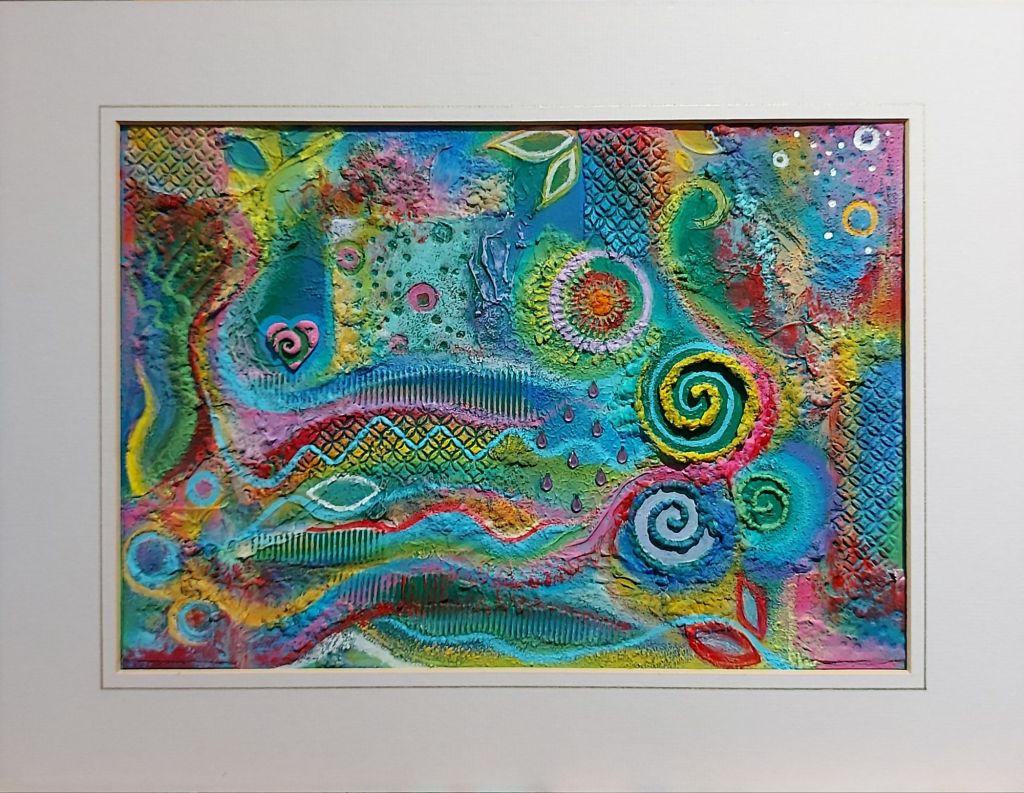
Creative block is something most of us arty types have to wrangle with at some time or other, for different lengths of time, a lot or a little, for a huge number of reasons.
It infuriates me beyond belief how frequently I get to a certain point in a painting I was so excited and hopeful about at the start and suddenly have no idea what to do next, though I know it’s not finished.
I’ve thought a lot about this troubling affliction over this past couple of weeks and how much of a failure I have been feeling about still not having completed the painting for my colleague.
Having trawled the internet, it’s comforting to find I’m very much not alone. I’ve read lots of articles and watched YouTube videos, many artists have shared a wealth of thoughts and solutions for creative block and of course different methods will have different levels of success for each person, but I’d thought I’d compile a list of my favourites as well as things I’ve learnt through my own experience so it’s all in one place to refer back to and maybe others will find it useful too. This is mainly relating to how I work on abstract paintings, but I’m sure a lot of it will be relevant to many other creative endeavours.
1. Take a break
I’ve seen this advice a lot. I’m often guilty of ignoring this as it can feel frustrating when you want or need to get a painting finished but it is a necessary part of the process. Don’t waste time fighting with your work if inspiration is not forthcoming, walk away and try again later. Forgive yourself, refuel and relax.
Some ideas for things to do when taking a break include: drink some water, eat some healthy food or take a vitamin, go for a walk, run or swim, go outside and look at nature, have a bath or shower, do a puzzle, do some housework, call a friend, watch something entertaining or go to bed! Alternatively…
2. Play
There are sooo many ways to interpret this but essentially art should be fun! Lose any fears you have, do what feels good, keep it light and joyful and trust yourself and the process. Stop chasing perfectionism and try to adopt a devil may care attitude. I’ve often found that some of my most successful work has been when I wasn’t putting any pressure on myself to do anything in particular, and it just happened!
Get out of your comfort zone and do some experiments- perhaps play with a different medium, textures or colour scheme. Explore or invent new techniques. Use a sketchbook. (Turns out there’s an awful lot to be said for using sketchbooks so that will be saved for another post!)
Give yourself a challenge. Some ideas:
10 minute/ 10 second drawing
Limit the materials or colour palette you’re going to use.
Paint what the way you’re currently feeling would look like.
Do something monochromatic.
Paint with something unusual like sticks or cotton buds, or use your fingers.
Paint to a song and paint what it would look like.
Paint pretending to be a 5 year old!
Paint something silly or deliberately try to make a bad painting then laugh at it!
Make a jar containing bits of paper with different ideas, techniques, colours etc written on them and pick one or more out for a random starting prompt.
Start a new piece of art or even more than one, it’s okay to have a number of works on the go at once, sometimes the solution to what’s wrong on one piece will arrive whilst working on another.
Use the time you’ve set aside to make art creatively, however you can. Do whatever you feel like as long as you’re not going days or weeks at a time without being creative.
3. Spend some time researching
Look through books, Pinterest, Facebook art groups and search the internet to find other art you like that inspires you, then compile a collection of your favourites to look back on whenever you need an inspiration boost. Think about how they have been created and practice replicating bits of other people’s work to get new ideas to inform your own.
Watch YouTube videos and tutorials about techniques, art theory and works in progress. Learn as much as you can about the elements of composition to truly understand why something might look ‘off’.
Sometimes I take a photo of a work in progress and do a Google image search on it to see what it shows me, I might get new ideas, find someone else’s work that I love or it might just let me know whether I’m on the right track for the feel of a piece I was aiming for and if it fits with other similar things I like. I have a Pinterest board for experiments/ work in progress which I use in the same way, as Pinterest will show you similar/related images underneath everything you click on.
Taking a look back through your sketchbooks can also remind you of things you want to try, recreate or continue working on and can often spark new ideas.
4. Do a ‘brain dump’
Write down all the thoughts you have about a piece, anything that might be bothering you or what could be causing the stagnation. Write them randomly as they pop into your head in no particular order, it doesn’t have to be in lines on the page or look any particular way, just get the thoughts out until everything is exhausted. I find this helps to release negative feelings and make sense of the whirling thoughts and sometimes new ideas and solutions arise.
5. Put some music on
Or a podcast, radio show or audiobook. Music especially can help shift your mood if that’s what’s getting in the way of being creative!
6. Teach someone else
I’ve often found that showing others how to achieve a particular technique or helping them learn to work with a new medium has helped me on my creative journey. It boosts confidence as you find out how much you do already know, it can reignite your passion as you are reminding yourself of things you love doing and can also spark new ideas, in the same way as if you…
7. Talk to other artists
Ask artistic friends to look at your work and give you their thoughts. Bouncing ideas off someone else often helps to clarify things, gain a different perspective or generate wonderful new ideas. There are lots of lovely artists on Facebook groups who will happily give feedback if requested, so it’s sometimes helpful to post works in progress.
The above should all help to be able to…
8. Look at it with fresh eyes
This could just mean after having taken that break and spending some time physically away from it, or it could be finding new ways to look at what you’ve done. I often look at my work in the mirror or in photographs that I take regularly through the process to get a different perspective and sometimes it’ll give me a little spark of an idea. Sometimes it helps to edit the photos and look at them in greyscale, as this can highlight imbalances in contrast/tone.
Turning the piece on it’s side or upside down can help to see it in another way and can make an area that isn’t working more obvious. Sometimes inspiration might strike and prompt you to add something, then when you turn it back the other way it feels better.
Try overlaying sections with pieces of paper to test whether it would be better without them and imagine what could be different. Squint at it. Try looking at it from much further away. Look at it in a literal different light!
9. Nurture self belief
Talk to yourself kindly. Look back at past work you were happy with, positive comments people made on things you posted online, think about any work that has sold or that other people have appreciated.
Pretend you know exactly what you’re doing (fake it ’til you make it!) and don’t let yourself get scared. The key thing is to lose the fear of it being a failure or a mess. Making mistakes is how we learn and grow, so embrace when it doesn’t go ‘right’. You can always just paint over it if you don’t like it and it will evolve into something else. Keep doing that until you do like it! Remember there is no such thing as perfection, some people will love something that others hate.
10. Practical Steps
It can help before you begin a piece to set some boundaries for yourself so it doesn’t get too overwhelming, for example, choose a limited colour palette, number of materials, size, theme etc. Come up with a brief for yourself.
Keep going. Take the pressure off by taking small steps. Begin on a ‘stuck’ piece by only committing to doing a tiny bit, even if it’s just one mark, or telling yourself you’re just going to spend 10 minutes on it. Often that’s enough to get you in to creative mode and you find you don’t want to stop. Try working on a few paintings at time, alternating and doing just a little on each.
Collaborate with the piece and ask it questions as if it were a living entity. Let it speak to you and tell you what it needs. Does it want a bit more red in that corner? A splash of something contrasting near the top left? Is there enough drama, or too much? Imagine alternatives- what if this grey section had a pop of lime green? Would that light area be better if it were darker?
Stand back a lot and look at the piece as a whole as you work.
Ask yourself why you don’t like the bits you don’t like. Start working on the bit you dislike the most, then move on to the next ‘worst’ bit.
Try making a drastic change, perhaps something you wouldn’t have naturally been inclined to do, like adding a chunk of a colour you weren’t planning to use or covering over a large section. It can be scary to paint over something you’ve already put time and effort into, not knowing whether what you may do will be better or worse, but if it wasn’t working anyway, what do you have to lose? If at first you don’t succeed, try, try, try again!
Switch things up a bit, use different tools or brushes to apply the paint differently and make different kinds of marks. Try working faster than usual. Try using your non dominant hand, or even your foot, or mouth!
Try not to get too attached to what you’ve done too early on, this can stifle your creativity by making you too protective of parts of it, which can prevent the free flow of mark making and you can ‘clam up’, which stops it becoming what it was destined to be!
Let go of the thoughts of what it was going to end up like in your head before you began. Let it evolve and grow naturally.
There are no failed paintings, only unfinished ones with endless possibilities, so never give up!
Phew. Now I’ll surely never get stuck again!?! What do you do to get rid of creative block? I’d love to hear from anyone who can add any other pearls of wisdom, please leave me a comment 😊
 alison m williams